
World Health Summit – GBD 2023 panel discussion: Translating evidence to agendas for health systems
Published December 12, 2025
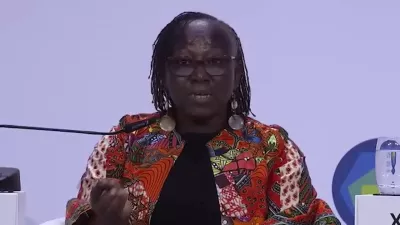
IHME announced the release of GBD 2023 study at the World Health Summit on October 12. A panel of global health leaders and IHME experts discussed the latest research from GBD 2023 — progress on life expectancy and child health, the increasing burden of mental health and non-communicable diseases, and the power of data to improve health systems.
Video Source: World Health Summit
Video transcript
This transcript has been lightly edited for clarity
Jane Halton (JH): So, Irene, coming back to thinking about the transition that’s underway throughout the world, what do you think some of the challenges for low- to middle-income country health systems are? I mean, what do we do in those contexts?
Irene Agyepong (IA): I think there are so many things, but let me just do two.
JH: That will do. Let’s start with two.
IA: Okay. I think there’s the old continuing challenge of resource availability. There’s nothing new there. But on top of that is the continuing question that if I only have so much, how do I optimize what I get out of it? And I think some of it comes back to the last slide Chris showed. And I think also on top of that, I would raise the issue of does it always have to be either/or? How do we enable more collaborative problem solving, out-of-the-box thinking approaches so that sometimes it might just be possible that it doesn’t have to be either/or.
If I can just use an example from my own country, when we were thinking through how do we get rid of out-of-pocket payments, can we do national health insurance, the global consensus was in a low-income country in sub-Saharan Africa it’s almost impossible. We spent hours and hours brainstorming, what do we do? At one point it almost fell apart because of two very powerful players – one felt it has to be classical social insurance, you know employer-employee, and another powerful player said how on earth do you do that when only 20% of the country is in the formal sector? In the end, we only jumped that hump because we dropped the either/or thinking and we ended up with a scheme which has a bit of everything. People kind of just decided let’s just do what we can. So that’s an example of that.
I think the second issue I would like to raise is both a threat and an opportunity: What do you do with dwindling global support? Because global support has made a huge difference. And I’ll use the example of immunization because I have a very personal interest. My mother’s generation feared measles. My little sister died of measles, so I also feared it. There was no EPI program in my country back then. As a young doctor, I remember my pediatrics rotation. In fact, when I saw the pictures from New York of COVID, I said that’s my pediatric rotation as a young doctor. You had children coming in and dying and sometimes they were forgotten on the trolley because everybody’s overwhelmed. It’s all gone. The young doctors of today in my country have never seen a case of measles. And I think sometimes when you’re not afraid of something it’s because somebody else has cleared the threat. Is the world going to wait to see this threat again before we realize what we have lost? And in the session in the morning, I think one speaker said health is a global good. It is. It’s a bit like you throw a stone into a pool – the ripples go well beyond where you threw the stone. So those would be my two comments and I stop for now.
JH: Ximena, Latin America: rapid shift – obesity, fasting plasma glucose are leading risk factors, and of course we’ve still got the issues around infectious disease, so we’ve got that dual burden that we’re dealing with. So, what are the interventions that are being thought of in this context? You know, particularly in Chile, but more broadly in Latin America, to actually think about this transition. Are there things that are happening there that you feel positive about or you want to talk about or what isn’t happening that should?
Ximena Aguilera: First, intersectoral and legislation is very important to tackle non-communicable diseases. We have been working on that in Latin America – for example, the control of tobacco, the convention of tobacco, all the global work and the global environment to move forward to this legislation has helped. The example from Australia, for example, has been improved. And that is the context of our policies. We cannot tackle any diseases alone as a health system. But the health system could be improving their outcomes. As Chris showed, a very different kind of behavior in the results, outcomes from the health system related to the way that you organize the health system. In our case, in the region and especially in my country, for us, primary health care is the backbone of the system. It’s the most important thing, because with the primary health care you can reach the population and coverage is the first thing to have any kind of different results with the health system.
In the case of my country, we this year mark 20 years since the creation of our explicit health guarantees scheme that was based on the burden of diseases. We worked on this 20 years ago, it’s updated every three years, and we include in this health guarantee system guarantees to access, to timeliness of care, out-of-pocket protection, financial protection, and also quality. And now this package this year is going to rise to 90 health conditions that is 80% non-communicable diseases. This huge package was built based on evidence that is delivered mainly through primary health care as allows us to implement evidence-based knowledge in a population manner in the health system, and we have had good outcomes of that. We still have many problems, of course, like any country – that is everybody is going out from the pandemic that is huge a disruption in the health system. But still, this 20 years of implementing this evidence-based intervention based on the burden the disease, on the feasibility, also on the adaptation of the responses to the local level in primary health care, has allowed us to improve our situation to reach a very high expectancy of life and to have good results.
JH: Richard, we’ve heard from a number of the speakers on the panel on the impact of COVID-19. We all know that we came out of COVID-19 really having been set back very significantly on things like the SDG goals. We had a great level of ambition in 2015, and then we got knocked sideways by this experience, and a number of the things that our panelists have talked about have added to those difficulties. Can we use the GBD to help us set a new course, a new agenda to actually achieve those really ambitious objectives which I don't think any of us resolve from. I think they’re still important. So what’s the ambition, Richard?
Richard Horton: Well, first of all, let’s just pause, stop even, and rethink and reset, because let’s put this into context. So we had eight Millennium Development Goals, 21 targets. Then we have 17 Sustainable Development Goals, 169 targets. So what’s going to come after 2030? 30 or 40 development goals and what, 300, 400 targets? I mean, we cannot continue like this. We are constantly splitting and dividing and fragmenting and breaking apart our vision for the future instead of finding linkages, associations, dependencies, connections between all of these issues that we that we care about. So, we need a new framework, first of all – however the GBD fits into it, we need a new framework. It’s a framework and you’ve seen it in your votes. Why do we separate food systems from health when we know that dysfunctional food systems – this was in the Lancet Commission we published last weekend – dysfunctional food systems are the biggest driver of planetary boundary transgressions, and we don’t see food systems as part of a health issue. This is madness! We separate out gender from health, and yet we don’t see gender justice as an indispensable part of what it is to attain the highest attainable standard of health. We have to bring gender justice together with health. Not just have SDG3 and SDG5. We need to go beyond under-5 mortality – Zulfi mentioned this – to integrate adolescent health. We need to go beyond the climate crisis and think about other environmental threats such as plastics and health. So we need a completely new framework for thinking about development. I don’t have a perfect solution, but I would invite you to look at a Commission we published earlier this year led by Andrea Winkler and John Amuasi that tried to redefine One Health, making it much more inclusive of non-communicable diseases, health systems, food systems – integrate not split.