
World Health Summit – GBD 2023 panel discussion: State of global health
Published December 12, 2025
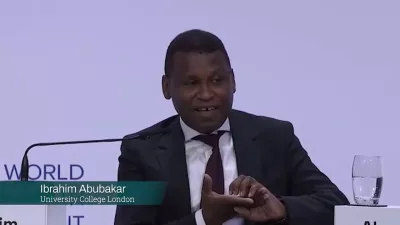
IHME announced the release of GBD 2023 study at the World Health Summit on October 12. A panel of global health leaders and IHME experts discussed the latest research from GBD 2023 — progress on life expectancy and child health, the increasing burden of mental health and non-communicable diseases, and the power of data to improve health systems.
This video explores insights from the Global Burden of Disease 2023 on the state of global health today. A panel of experts from the World Health Summit discuss changes in life expectancy, disease patterns, and key risk factors around the world.
Video Source: World Health Summit/
Video transcript
This transcript has been lightly edited for clarity
Jane Halton: So let’s start, shall we? Zulfi, you have very particular perspectives, I think, in these areas and the really dramatic decline we’ve seen in child mortality over that period that Chris has just shown us from 1990, particularly from vaccine-preventable diseases and the neonatal disorders that we’re aware of. But of course, we know that there are uncertainties—things are fragile in terms of success.
So, we’ve just seen the vulnerabilities that we’ve all experienced courtesy of the pandemic. What do you think are the interventions that have actually helped drive those gains? What are the things that we should hang on to as being important?
Zulfiqar Bhutta: Take charge of your own health systems and your own social systems yourself. Every country in the world, barring a few which are heavily indebted countries, has the capacity to do more, and I think for women and children’s health, the first and foremost thing that would make a difference is domestic financing for health. I come from a region where we spend far, far more on defense and other expenditures that we do on social systems, on education, on empowering women and girls and improving primary care and universal health coverage. So I think that would be my core message.
The second would be, as I said, do the right things, do the evidence-informed interventions, but for heavens’ sake do them right, which means also the implementation strategies to reach the poorest of the poor and marginalized population.
My final point on that, if I may—and I was talking to Chris a short while ago—is really the importance of information systems, data. We know we’re running into a situation right now—there was probably a meeting today on what will happen to DHS systems, now that all of a sudden there is a panic that these surveys are going to disappear or have disappeared to some extent.
I think that’s a great opportunity for countries to take charge and move into vital registration systems that are within their grasp. I was talking to you today about how a small country like—I shouldn’t say small beyond the population—like the Kyrgyz Republic has a birth data registry that covers all pregnancies and child births in that country. If they can do that, many other middle-income countries, low- and middle-income countries can.
So one message to ministers representing different sections is the eye does not see what the mind does not know, and to make the mind know things, data, and particularly solid information from your own geographies, is probably the most important intervention.
Jane Halton: Ibrahim, we’ve already heard about the Sahel in this presentation. High child death rates and some progress, but high population growth, increasing burden due to high temperature, something I think we’re particularly alert to. And in some countries, challenges exacerbated by political instability. And this is an impossible question, and I therefore apologize in advance. If you had to give me literally your top three or four things that should be focused on in terms of the barriers to overcome to improve health in that region, what would they be? Unadorned, the top three or four.
Ibrahim Abubakar: The Sahel is the region that had the Ghana Empire, the Mali Empire. When Europe was busy split between the Byzantine Empire and the Holy Roman Empire, we had universities in Timbuktu. We are as human as everybody in this room, right? And we have the intellect to organize. If some of those factors are explained, the interference, if human capital is allowed to grow, if people are educated, that massive youth bulge that we are worried about at the fertility rate actually could improve the determinants of health.
So for me, one of them is education and addressing the levels and the skills and the potential. Second, the minerals available to the people of the Sahel that people are exploiting. If a fair wage is given and you can generate the economic revenue to do that, then yes, you can increase wealth and be able to do that.
Third, the sun. The Sahara is a massive place, right? So sustainable energy—we could be part of the solution in the Sahel. And then finally, good governance, provision of public health, and primary health care would shift many of the conditions that are causing the absolutely dismal outcomes that are fixable, because they’ve been done in every other world region. And if we provide the necessary immunization, nutrition, and those services, we will transform outcomes for the people of the Sahel. Thank you.
Jane Halton: So, Alarcos Cieza, please, this GBD report shows us that non-communicable diseases including cardiovascular disease, chronic kidney disease, cancers, diabetes, you know, we could go on, now account for 75% of global deaths and 65% of global DALYs. I think that change that Chris just showed you is really stark. And so that speed of this transition in low- to middle-income countries and upper-middle-income countries is really, really quick. Can you tell us what you think those patterns and drivers are of this epidemiological transition?
Alarcos Cieza: Look, the main messages have been already said: the transition from communicable diseases to non-communicable diseases has happened or is happening absolutely everywhere. However, it is happening in an accelerated manner in sub-Saharan Africa and South Asia, and we can see very clearly that transition looking at premature deaths, deaths that happen before the age of 70.
From all these deaths that happen before the age of 70, one in three is due to cardiovascular diseases, to respiratory diseases, to cancer, to diabetes and kidney diseases. And we are talking about 17 million premature deaths every year. And to see the relationship, or the extent of this impact, we need to think that every year approximately the same number of people died during COVID-19 in the three years of the pandemic.